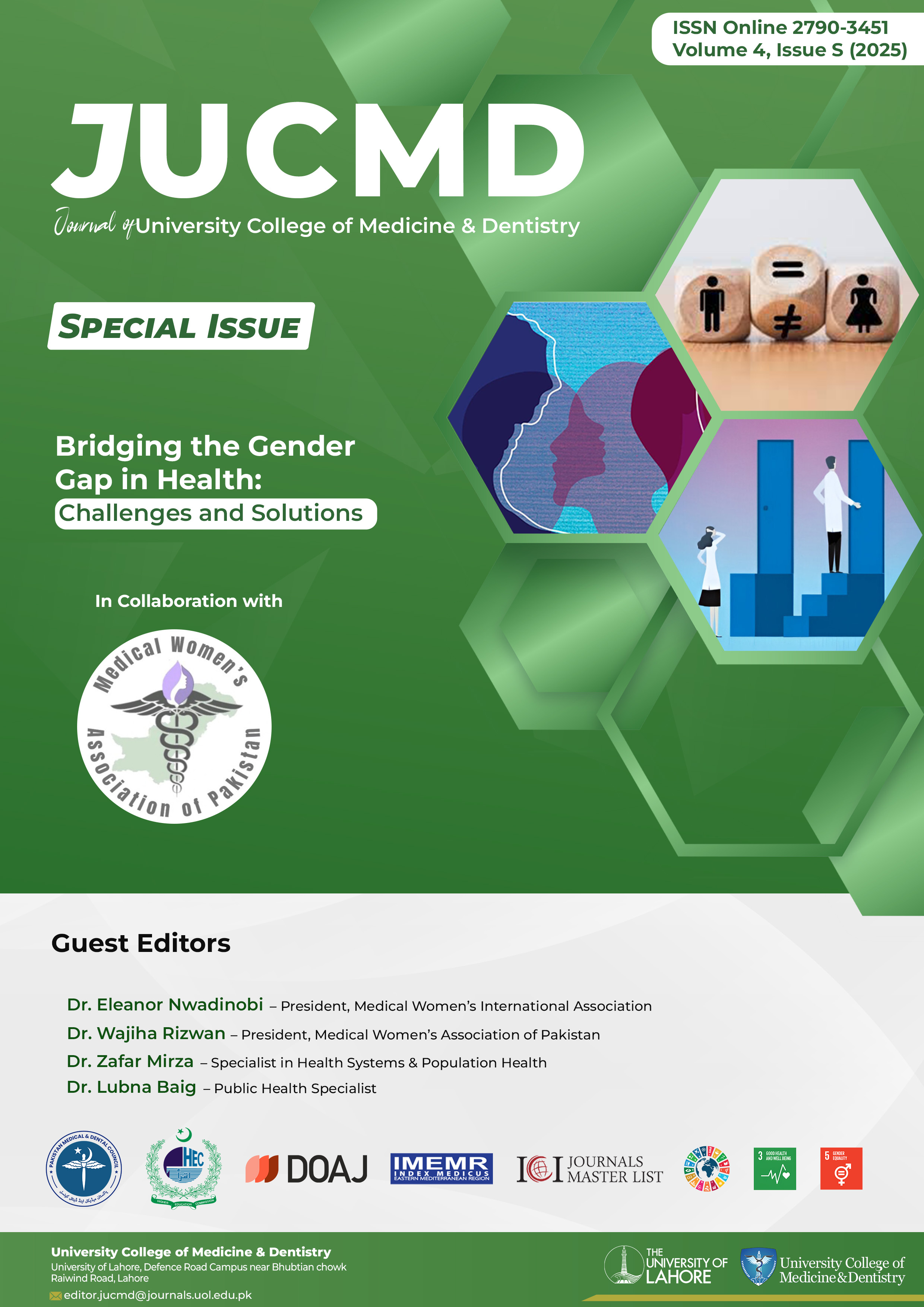
Women's Health Crisis in Pakistan
DOI:
https://doi.org/10.51846/jucmd.v4iS.3854Abstract
This editorial highlights the critical health crisis faced by women in Pakistan, affecting nearly 120.7 million citizens. Gender inequality, poor reproductive healthcare, and systemic neglect contribute to the widespread health challenges women face throughout their life course. Key issues include high rates of malnutrition, anemia, undernourishment, and a high fertility rate, with significant disparities in rural areas. Women also face a heightened risk of communicable and non-communicable diseases, including the highest breast cancer rate in Asia. Economic factors, such as low workforce participation and wage gaps, further exacerbate these challenges. The editorial calls for comprehensive healthcare reforms focused on governance, financing, and addressing gender biases to improve women’s health and create a more equitable healthcare system. Addressing these disparities is essential for empowering women and enhancing their well-being.
Key Words: Gender disparity, Reproductive health, Malnutrition, Anemia, Healthcare reforms
Downloads
Downloads
Published
How to Cite
Issue
Section
License
Copyright (c) 2025 Zafar Mirza

This work is licensed under a Creative Commons Attribution 4.0 International License.
Authors retain copyright and grant the journal right of first publication with the work simultaneously licensed under a Creative Commons Attribution 4.0 International License that allows others to share the work with an acknowledgment of the work's authorship and initial publication in this journal.
Authors are able to enter into separate, additional contractual arrangements for the non-exclusive distribution of the journal's published version of the work (e.g., post it to an institutional repository, in a journal or publish it in a book), with an acknowledgment of its initial publication in this journal.
Authors are permitted and encouraged to post their work online (e.g., in institutional repositories or on their website) prior to and during the submission process.